
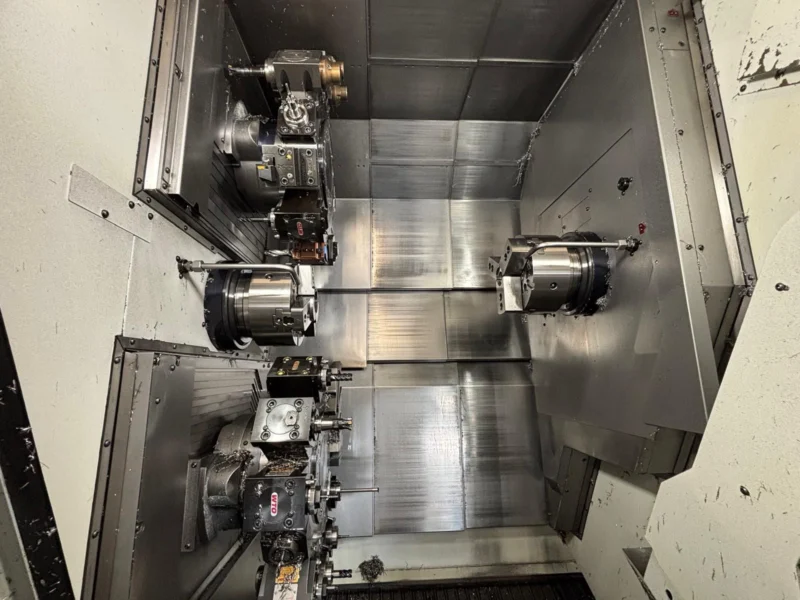
📷 IMAGE SLOT — CNC vertical machining centre and investment decision theme · 1200×630 px · WebP/JPG · <150 KB · file name: cnc-machine-investment-part-1.webp · alt: What to consider when investing in a CNC machine
For most workshops, a CNC machine is one of the largest equipment investments they will ever make. Yet the decision is too often reduced to two questions: “How much?” and “Where is it made?” In this two-part interview series we discuss how to get the investment right with the Mentor CNC editor, who has spent more than 20 years across the industry — as an operator, in CNC sales, in technical service and as a representative of a global cutting-tool brand. This first part covers buying habits, budget mistakes and how machine pricing really works behind the scenes; part two goes into the technical selection criteria: guideways, spindle and control unit.
Let’s state the single main idea of this series up front: The top of the list is always the part you will machine — its material, its quantities, its quality standard. The machine takes shape according to that answer, not the other way round.
Q: How does the CNC machine buying process usually work? What do buyers look at first?
Mentor CNC: To be frank, the choice is driven largely by price and country of origin. The buyer first forms a size in their mind: “Do I need an 800-class or a 1000-class machine?” Up to this point the logic is sound — sizing the working envelope to the job is the correct first step. But once the size is settled, no technical analysis follows; the process jumps straight to price research. A sorting begins: Japanese, German, Taiwanese or Chinese? Because German and Japanese machines usually exceed the budget, the needle gets stuck between Taiwan and China. The rest is familiar: “This one is 50,000 dollars, that one is 45,000.” The decision collapses onto a 5,000-dollar difference.
On the technical side only two or three criteria get checked: box way or linear guideway? How many rpm is the spindle? Everyone wants the same thing — high speed, high power, linear guideways. But nobody asks: Is my work actually a linear-guideway job? Do I really need 12,000 rpm, or does 8,000 rpm cover my work comfortably? When these questions go unasked, sellers sweeten the deal with small accessories — LED lighting, an oil skimmer — and close on price.
Q: You have spent over 20 years on both the operator and the sales-service side. What is the most common investor mistake?
Mentor CNC: I started in this trade as an operator; later I worked in CNC sales, technical service and as a representative of a global cutting-tool brand. Based on all of that experience I can say it plainly: everyone claims “I choose the machine for my job”, but the final decision rests either on a budget illusion or on overcapacity the job does not need.
The classic mistake is the sentence: “What if a big part comes in once a year?” A machine with an 800×500 working area and an 8,000 rpm spindle fully covers the company’s work. But “in case a bigger job arrives”, a 1200-class machine is bought instead of the 800, the spindle is pushed to 12,000 rpm for no reason, and an investment that could be solved for 40,000 dollars climbs to 50,000. Ten thousand dollars are paid purely for a possibility. The same happens with guideways: companies that need linear buy box way, and companies that need box way buy linear.
Q: A company calculates every line item when quoting a part. Why is the same discipline not applied when buying a machine?
Mentor CNC: A critical point. What happens when a technical drawing arrives at a workshop? Material supply, price quotes, transport, machining time, the likely scrap rate… everything is calculated line by line. The same rigour should apply to buying the machine. Everyone wants the best machine at the lowest price, but no such reality exists in the market. What works is to cost the machine item by item — exactly the way you quote a part.
Q: How does pricing between the factory and the distributor actually work? Are flat figures like “an 800-class machine costs 40,000 dollars” real?
Mentor CNC: Speaking as someone who has seen the kitchen: there is no such thing as a round number at the manufacturer level. The factory configures the machine like an automation system. It says: “Choose a 6,000 rpm spindle instead of 8,000 and the machine comes to 30,372 dollars and 30 cents.” Every component has an exact price — down to which control model you pick and even a single software option: figures like 150, 272 or 300 dollars are quoted for one parameter package. A 12,000 rpm spindle instead of 10,000 is one delta; direct drive instead of belt is another; 42 mm guideways instead of 32 mm is another…
The distributor, meanwhile, looks at its own market: “these features sell here”, and turns machines into standard packages. A machine that could be configured at the factory for perhaps 30,000 dollars — and would exactly cover the need — arrives at 40,000 with the standard package and is offered at a rounded 50,000. When you buy an automation system, what do you do? You select what you need and compare two or three configurations. That is also the right way to buy a machine — but the market has settled into the package habit.
Q: What is the real-world result of this package habit and of hearsay-driven decisions?
Mentor CNC: The result: machines used for the wrong job, with their service life cut in half. Operators tire faster, service costs multiply. And a striking picture appears: of two companies running the exact same brand and model, one praises the machine while the other is deeply dissatisfied. One says, “Excellent machine — I cut dies on it and spare parts too”; the other says, “I can machine neither dies nor parts on it.” Why? Because the satisfied company machines mostly steel, while the unhappy one has used the machine 80 percent on heavy cast iron. When I ask, “Why did you buy this machine?”, the answer is always the same: “It was one of the best machines on the market; we assumed it would do our work.”
Responsibility does not sit on one side only. The seller fails to give the right warning, or pushes the standard package; the buyer, instead of technical analysis, looks at the neighbouring workshop. Even if you tell the buyer “this configuration does not suit your cast-iron work”, the reply is ready: “But the company next door is delighted with it — they machine big steel parts.” The efficiency your neighbour gets in steel does not mean you will get the same in cast iron. Every material has its own cutting dynamics; every machine has its own rigidity, guideway structure and torque requirement.
Q: What do you say to buyers who choose by brand out of fear that “the resale value must not drop”?
Mentor CNC: Resale value, brand recognition, market demand… These are parameters; they get considered. But they cannot come first. First place always belongs to your own work and your own parts. A new CNC machine is not an asset to be flipped a year later. Buying a machine with the logic of “if I close the business in three years I can sell it easily” is, in my view, the wrong starting point — that is my opinion, and I respect those who think differently. The sentence to build on when buying a new machine is: “I will earn with this machine for as long as I run it.”
Q: How should production be planned to speed up the return on such a costly investment?
Mentor CNC: CNC machines are high-cost investments, and they are designed to run 24 hours a day — the spindle, the guideways and the control are all built for that tempo. Buying a 60,000-dollar machine and running it only on a single day shift, leaving it idle at night, is in my view a serious business mistake. Companies — especially new ones — should build their business plan around this: at worst the machine should be fed with two shifts of work, ideally three. Dies or spare parts, whatever the work — every hour the machine stands idle is a hidden cost. These machines pay back the invested capital only while they are running. To put concrete numbers on machine hourly cost and tooling efficiency, you can use our Cutting Tool ROI and Efficiency Calculator.
Q: Summing up this part?
Mentor CNC: When buying a machine, look first at your own company and the parts you machine. Price, origin, brand, resale value — all of it is weighed, but none of it leads the list. The top of the list is fixed: the material to be machined, the part quantities, the required quality. And you will buy the machine the way you quote a part — calculated line by line.
In part two we get into the technical side: box way, ball-type or roller-type linear guideways? How to choose spindle speed and torque? Ceramic or steel bearings? Where can you save on the control unit — and where should you not? Continue here: CNC Machine Selection — Part 2: Box Way or Linear?
What is shared in this article is not a rulebook; it is practical advice distilled from more than 20 years of shop-floor experience. Every opinion is valuable; every business should decide according to its own priorities.