
On a CNC machine the coolant takes care of the cut, but the machine itself depends on three other lubricants. Way oil lets the axes move smoothly and without chatter. Hydraulic oil drives the chuck, the tailstock and the tool clamping system. Grease protects bearings and sliding surfaces where liquid oil will not stay. If any of the three is the wrong type or is neglected, the result is the same: dimensions drift, the ways wear and the machine goes into alarm. This article covers each of them: where it is used, how it is classified and how to choose it.
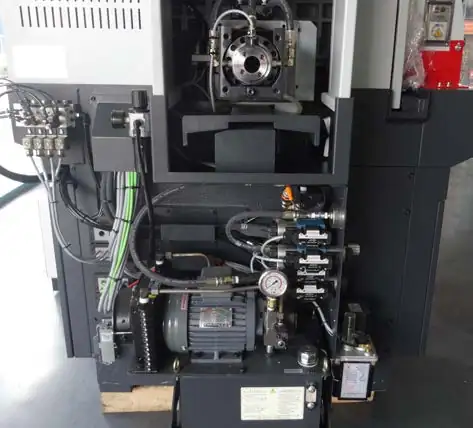
Two Basics First: Viscosity and ISO VG
Viscosity is an oil’s resistance to flow; in short, how thick the oil is. Its unit is mm²/s (formerly centistokes, cSt). Oil thins as it warms up and thickens as it cools, so viscosity is always stated together with a temperature.
ISO VG (viscosity grade) classifies industrial oils by their viscosity at 40 °C. The number in the oil’s name is the mid-point viscosity at 40 °C; the actual value lies within about ±10% of that number.
| ISO VG | Viscosity at 40 °C (mm²/s) | Typical use on a CNC machine |
|---|---|---|
| 32 | 28.8 – 35.2 | Hydraulic systems |
| 46 | 41.4 – 50.6 | Hydraulic systems |
| 68 | 61.2 – 74.8 | Horizontal ways, central lubrication |
| 220 | 198 – 242 | Vertical and heavily loaded ways |
The viscosity index (VI) shows how much an oil’s viscosity changes with temperature. An oil with a high VI keeps its thickness better both on a cold morning and in a warm afternoon.
The machine builder’s lubrication chart always decides which oil goes where. It lists the oil class, viscosity and change interval for every point. What follows is meant to help you read that chart and choose the right oil with confidence.
1. Way Oils (Slideway Oils)
What Is Way Oil and Where Is It Used?
Way oil is a special oil made to lubricate the surfaces the machine axes slide on. On a CNC machine it goes to:
- Box ways (sliding ways) and table surfaces
- Linear guide carriages (on oil-lubricated designs)
- Ball screw nuts
The differences between box ways and linear guides are covered in our CNC machine selection: box way or linear? article.
A central lubrication unit delivers the oil to these points. At set intervals it pumps small amounts of oil through distributors to every point. When its reservoir runs empty or no pressure builds up, the machine raises a lubrication alarm.
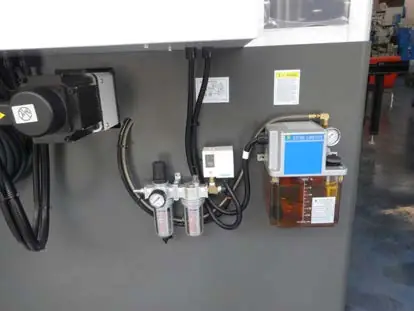
How Does Way Oil Differ From Ordinary Oil?
Unlike an ordinary machine oil, way oil has the following properties:
- Tackiness: it does not run off vertical ways and is not easily washed off by the coolant spray.
- Stick-slip prevention: it contains additives that stop the axis from moving in jerks at very low feed rates.
- Load-carrying capacity: it keeps the oil film under high pressure and prevents metal-to-metal contact.
- Rust and oxidation protection: it protects the ways from moisture and coolant and lasts a long time.
- Coolant separability: when it reaches the coolant sump it does not emulsify; it floats to the top and can be skimmed off easily.
- Seal compatibility: it does not attack seals.
What Is Stick-Slip?
If friction on the ways rises and falls while an axis moves very slowly, the axis does not move smoothly; it sticks, then suddenly slips. This is called stick-slip. In precision work it shows up as lines on the surface, dimensional waviness and a distorted circle in a ballbar test. The special additives in way oil even out friction at low speed and prevent it. This is the best-known damage done by putting ordinary oil on the ways instead of way oil.
Way Oil Classes and Viscosity
Internationally, way oils are classified as L-GA and L-GB under ISO 6743-13; the German standard calls them DIN 51502 CGLP. The letters in CGLP mean:
| Letter | Meaning |
|---|---|
| C | Circulating oil (base lubricating oil) |
| G | Slideway oil: tackiness and anti-stick-slip additives |
| L | Rust and oxidation inhibitors |
| P | Anti-wear and load-carrying additives |
Two viscosity grades are the most common on CNC machines:
- ISO VG 68: horizontal ways, small and medium machines, central lubrication systems
- ISO VG 220: vertical ways and large, heavily loaded machines
If the machine builder’s chart gives a different value, use that value.
Where Does Way Oil Go? Recirculating and Total-Loss Lubrication
- Recirculating system: the oil is collected after lubricating the ways and returned to the reservoir. Here the sealing between way oil and coolant must be very good; coolant getting into the way oil ruins it.
- Total-loss system: the oil is not returned, so the ways always receive fresh oil. Most CNC machines work this way, and the used oil eventually runs into the coolant sump with the chips.
In the second case way oil becomes tramp oil in the coolant. It forms a layer on the sump, feeds bacteria and makes the emulsion smell and break down sooner. That is why “good coolant separability” is a property to look for on a way oil’s data sheet. The consequences are explained in detail in our CNC coolant (soluble oil) article.
What the Operator Should Watch With Way Oil
- Check the lubrication reservoir level weekly, or daily on busy machines. If the level drops faster than usual, have the unit setting and possible leaks checked.
- Fill the reservoir only with the class and viscosity given in the chart. No hydraulic oil, engine oil or whatever happens to be at hand.
- Fill from a clean container and do not remove the filler strainer.
- Do not clear a lubrication alarm and carry on. Ways and ball screws running dry wear quickly and accuracy is lost.
- After a long stop, first run the axes over their full travel at low speed so the oil reaches every point.
All the lubrication, air and hydraulic checks done at the start of a shift are listed in our daily operator checks on a CNC machining center article.
2. Hydraulic Oils
Where Is Hydraulic Oil Used on a CNC Machine?
A hydraulic system transmits power through the pressure a pump gives to the oil. Pressure applied at one point of a liquid is transmitted equally to every point, which is how a small pump produces large clamping forces. On CNC machines hydraulic oil drives:
- CNC lathe: hydraulic chuck, tailstock, turret clamping and indexing
- Machining center: tool clamping and unclamping, pallet changer, rotary table clamping, hydraulic fixtures
Hydraulic oil does more than transmit power. It protects the pump and valves from wear, helps sealing, protects parts from rust and carries heat back to the tank.
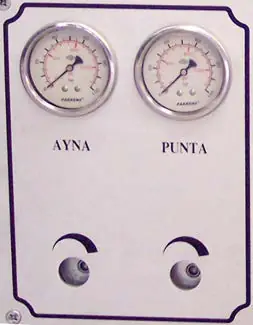
Hydraulic Oil Classes: HL, HLP, HVLP
Mineral-oil hydraulic fluids are classified under DIN 51524 in Germany and ISO 11158 internationally.
| DIN 51524 | ISO equivalent | Additives | Where used |
|---|---|---|---|
| HL (Part 1) | HL | Rust and oxidation inhibitors | Low-pressure, lightly loaded systems |
| HLP (Part 2) | HM | HL + anti-wear | Most machine tools; today’s standard hydraulic oil |
| HVLP (Part 3) | HV | HLP + viscosity index improver | Large temperature swings, cold workshops |
| HLPD | HG | HLP + detergent/dispersant | Systems where the machine builder specifically asks for it |
The oil’s name gives both class and viscosity. HLP 46, for example, is a hydraulic oil to DIN 51524-2 with ISO VG 46 viscosity. CNC machines most often use ISO VG 32 or 46 HLP; the exact value is on the hydraulic unit’s label and in the machine manual.
How Do You Choose Hydraulic Oil?
- Class and viscosity in the machine manual: check this first.
- Operating temperature: the viscosity must still give an adequate oil film at the highest operating temperature. Oil that is too thin leaks and wears the pump; oil that is too thick makes the pump struggle to draw it when cold.
- Seal compatibility: choose an oil that does not attack the seals.
- No mixing: oils with different additive packages can be incompatible. Top up with the same oil already in the tank; if you change type, drain the system and refill.
Hydraulic System Fault Symptoms
| Symptom | Likely causes |
|---|---|
| Oil foams | Pump sucking air, low oil level, leak on the suction side, water in the oil |
| Oil overheats | Wrong viscosity, clogged suction filter, wrong pressure setting, overloaded system |
| Pressure drops | Viscosity too low, pump sucking air, relief valve set too low, internal leakage |
| Pump is noisy and knocks | Pump sucking air, clogged suction filter, oil too thick (cold) |
| Chuck does not hold pressure, part slips | Pressure set too low, valve or cylinder seal leaking |
Do not run the machine with a hydraulic alarm or a visible leak. Low pressure on a hydraulic chuck in particular can throw the part out of the chuck. Only authorised maintenance staff should adjust valves and pressure settings.
Hydraulic Oil Maintenance
- Check the tank level and the oil’s appearance regularly. Cloudy oil means water, foamy oil means air, darkened and thickened oil means oxidation.
- The hydraulic unit oil is usually changed once a year; the filters are checked at the same time and replaced if needed.
- On larger systems an oil sample can be sent to a lab for viscosity, water content and particle count. Oil cleanliness is expressed as an ISO 4406 code, based on the number of particles per millilitre.
- When filling, keep dust, chips and water out of the oil; do not leave the tank cap open.
3. Lubricating Greases
What Is Grease?
Grease is a base oil thickened with a thickener. The thickener holds the oil the way a sponge holds water, and releases it slowly to the surface while the grease works. In most greases the thickener is a soap, formed by reacting a fatty acid with an alkali. Grease is used where continuous oil lubrication is not possible and sealing is not complete.
Where Is Grease Used on a CNC Machine?
- Grease-lubricated linear guide carriages and ball screw nuts
- Central grease systems (using fluid grease)
- Chuck jaw sliding surfaces and slots (with the grease recommended by the chuck manufacturer)
- Motor and auxiliary unit bearings
On most machines the spindle bearings are greased for life at the factory or lubricated by an oil-air system. The operator does not grease them; spindle maintenance is a job for authorised service.
Grease Consistency: NLGI Grades
Greases are graded by consistency with an NLGI number. Consistency is measured by how deep a cone of set weight sinks into the grease at 25 °C (penetration, in units of 0.1 mm). The deeper the cone sinks, the softer the grease.
| NLGI | Worked penetration (0.1 mm) | Appearance | Typical use on CNC machines |
|---|---|---|---|
| 000 | 445 – 475 | Fluid | Central grease systems |
| 00 | 400 – 430 | Semi-fluid | Central grease systems, enclosed gears |
| 0 | 355 – 385 | Very soft | Central grease systems |
| 1 | 310 – 340 | Soft | Bearings; central systems if approved by the builder |
| 2 | 265 – 295 | Medium | The most common bearing grease |
| 3 | 220 – 250 | Firm | Bearings; places where the grease must not run |
| 4 – 6 | 85 – 205 | Hard to block | Special applications |
Central grease systems pump grease through pipes and therefore need fluid grease (NLGI 000–0). Putting bearing grease (NLGI 2) into such a system blocks the lines, and no grease reaches the lubrication points.
Types of Grease: Comparison by Thickener
| Thickener | Dropping point (typical) | Water resistance | Heat resistance | Mechanical stability |
|---|---|---|---|---|
| Calcium | 90 – 110 °C | Very good | Poor | Good |
| Lithium | 180 – 200 °C | Very good | Good – very good | Very good |
| Lithium complex | 240 – 260 °C | Very good | Very good | Very good |
| Aluminium complex | Product-dependent | Very good | Very good | Good – very good |
| Polyurea | Product-dependent | Very good | Very good | Good |
| Non-soap (bentonite) | Very high | Good | Very good | Good |
The dropping point is the temperature at which heated grease becomes fluid and starts to drip; it indicates the grease’s heat resistance. Grease is not used up to that temperature; the operating temperature must stay well below the dropping point.
Greases contain anti-wear and extreme-pressure (EP) additives, rust inhibitors and, in some products, solid lubricants such as molybdenum disulphide or graphite.
How Do You Choose Grease?
- Speed: high-speed bearings use a firmer grease with a thinner base oil; slow movements use a softer grease.
- Load: for heavy and shock loads, choose a grease with EP additives.
- Temperature: the operating temperature must stay well below the dropping point.
- Application method: grease gun or central system? A central system needs fluid grease.
- Contact with water and coolant: where coolant splashes, choose a grease with good water resistance.
- Bearing type: follow the bearing manufacturer’s recommendation.
Greasing Do’s and Don’ts
- Do not mix greases with different thickeners. Incompatible greases can soften and run, or harden. If you change grease type, clean out the old grease.
- More grease is not better. Over-greasing a bearing makes it run hot. Take the quantity and interval from the manufacturer’s chart.
- Wipe the grease nipple before greasing; dirt and chips on it are pushed into the bearing with the grease.
- Keep the grease container closed; grease contaminated with chips or dust must not be used.
CNC Machine Lubrication Schedule
| Interval | Task |
|---|---|
| Daily | After switching on, run the axes at low speed so the oil spreads. At the end of the day, clean off chips and coolant and oil the table and way covers. |
| Weekly | Check the way-oil level and top up if needed. |
| Monthly | Lubricate the points that are oiled by hand. Check and clean the coolant and way-oil tanks. |
| Yearly | Have the ball screws, ways and oil distributors checked. Change the hydraulic unit oil; check air and oil filters and replace them if needed. |
The schedule is a general framework. If your machine’s maintenance manual gives different intervals, follow the manual.
Frequently Asked Questions
Can hydraulic oil be used instead of way oil? Generally no. Hydraulic oil lacks the tackiness and anti-stick-slip additives of way oil; it runs off vertical ways and can make the axis move in jerks at low speed. On some machines the builder approves one oil for both jobs; only the manual can tell you that.
What viscosity should way oil be? CNC machines most often use ISO VG 68 (horizontal ways, central lubrication) and ISO VG 220 (vertical and heavily loaded ways). The exact value is in the machine’s lubrication chart.
What does HLP 46 mean? A hydraulic oil to DIN 51524-2 with anti-wear additives and a viscosity of about 46 mm²/s at 40 °C.
How often should hydraulic oil be changed? On machine tools, usually once a year; earlier if the oil turns cloudy, foams or darkens.
What grease goes into a central lubrication system? A fluid grease that can be pumped through the lines (usually NLGI 000, 00 or 0). Bearing grease (NLGI 2) blocks the system.
Safety Notice and Disclaimer
Before working on the lubrication unit, the hydraulic system or the central grease system, isolate the machine and relieve the hydraulic pressure. Only authorised staff should adjust pressures and valves. The machine builder’s manual takes precedence for oil class, viscosity and change intervals. The information in this article is for educational purposes; Mentor CNC accepts no liability for direct or indirect damage arising from its use.
